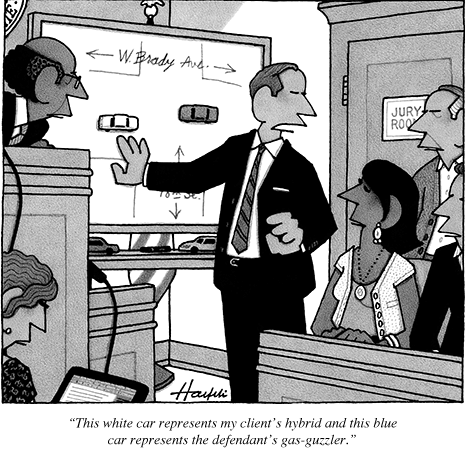
New Yorker, June 3, 2013
Wednesday, May 29, 2013
More P3 for new VA Facilities: Lease-Lease-Back for 30 years + Design Build
The San Francisco Business Times reports that the VA Medical Center San Francisco is looking for a public private partnership to fund a new $500 million hospital and research facility in Mission Bay. That's next to McCovey Cove where the Giants hit their home runs for those of you not from around these parts.
J.K. Dineen:
J.K. Dineen:
Given the tight fiscal constraints, and the slim chances that Congress would allocate money for a state-of-the-art medical center in San Francisco, U.S. Senator Dianne Feinstein (D-Calif.) asked San Francisco VA officials to come up with a public-private alternative, according to Bob Obana, executive director and CEO of the Northern California Institute for Research and Education, a nonprofit institute set up to support the local facility’s research.
“We went to Senator Feinstein and the senator said, 'If you guys bring back to me a public-private partnership alternative, something that would figure out a way to bring to the VA a different mechanism for financing medical centers, I would be more than happy to support that and bring it to the secretary,'” Obana said. ....
The public-private partnership — known as a P3 — could look similar to one that financed another Mission Bay building, UCSF’s $200 million, 237,000-square-foot neuroscience center. In that case a nonprofit group put together by UCSF is leasing the property from the UC system and financed construction through state bonds. The group then subleased the site to a partnership between McCarthy Cook & Co. and Edgemoor Real Estate Services, which in turn is leasing the building to UCSF over 30 years.
The report also explores the partnership that is financing the $1.1 billion Doyle Drive project. The $488 million second phase of that undertaking is paid for up front by a group of European investors in charge of designing, building and maintaining the parkway. It will be paid back over 30 years.
In addition to the San Francisco examples, Randolph’s team looked at P3s formed to finance a court house in Long Beach, a building at the University of Buffalo and public buildings in England, Canada and Australia.
“What we are finding is that the project is viable as a P3,” said Randolph. “It would be attractive to private investors. There is good precedent for this kind of facility.”In other words, lease-lease-back for 30 years, private financing, and no competitive bidding.
Saturday, May 25, 2013
Riks Mitigation in EPC Contracts: Division 4 Presentation by Philip Hamblin
Here is the presentation on identifying and mitigating project risks in EPC contracts, by Philip Hamblin of Criterium Consulting Group. Phil Hamblin is an Associate Director at Criterium consulting.
Date: Tuesday, May 28, 2013
Time: Noon Eastern time
Call No.: 866-646-6488
Code: 683-524-3965#
Phil Hamblin specializes in contract review and oversight, schedule preparation and analysis, risk avoidance, document management, and change order preparation and negotiation. He has serves as Contracts Manager for three power generating turbine plant projects located in Algeria where his responsibilities include overall risk management for the projects. He has a degree in Construction from Arizona State University, and a Juris Doctorate degree in Law from Rutgers School of Law, Camden. He is licensed to practice law in the state of Pennsylvania.
Join us for the presentation and discussion.
Date: Tuesday, May 28, 2013
Time: Noon Eastern time
Call No.: 866-646-6488
Code: 683-524-3965#
Phil Hamblin specializes in contract review and oversight, schedule preparation and analysis, risk avoidance, document management, and change order preparation and negotiation. He has serves as Contracts Manager for three power generating turbine plant projects located in Algeria where his responsibilities include overall risk management for the projects. He has a degree in Construction from Arizona State University, and a Juris Doctorate degree in Law from Rutgers School of Law, Camden. He is licensed to practice law in the state of Pennsylvania.
Join us for the presentation and discussion.
Thursday, May 23, 2013
Design-Build vs. Design Assist
Steve Murphy, PE, LEED, AP BD+C, and Director of electrical, mechanical, and plumbing services at Blach Construction explains his perspective on the difference between design-build, and design-assist. Blach Construction, founded in 1970, is a Northern California general contractor with offices in Silicon Valley, Monterey, and Sacramento. Their focus is building education, corporate offices, medical
facilities, historic preservation, high technology, and non-profits. They are an AGC member and are recognized as a great place to work. They were recognized by AGC-CA in 2010 and 2011 as having the best safety program in the state. They have a hip and effective website.
Here is Steve:
Here is Steve:
Design-Build and Design-Assist are not interchangeable. While these project delivery methods sound similar, they are in fact very different. The main difference I’ll address in this post is the designation of the firm that is legally responsible (and ultimately liable) for the design of the systems.
The project’s Engineers of Record (EORs) are design engineers that are responsible for interpreting the client’s needs and designing fully functional MEP systems for their building. Typically, there are different EORs for mechanical, electrical, plumbing and fire protection systems.
The drawings and specifications prepared by these EORs communicate the intent of the project to the building contractor. Ultimately, clients choose between what they want or what they can afford (I know it’s a shock, but these can be different at times!).
In a pure “Design-Build” project, the different EORs are typically employed/contracted by the Design-Build MEP subcontractors. These subcontractors are solely responsible for designing, installing and commissioning the MEP systems to satisfy the intent of the project. The different Design-Build subcontractors collaborate as a team and are responsible for informing each other of how their system will impact the project overall.
In a “Design-Assist” project, the MEP EOR’s are typically hired by the project architect. These EOR’s are responsible for the project’s design and they coordinate closely with the other design team members (architect, structural engineer, landscape architect, civil engineer, etc.) to ensure that each individual system is designed to meet the intent of the project.
Simply explained, MEP subcontractors are responsible (and liable) in a Design/Build project and the MEP consultant EOR’s and the architect are on the hook (from a liability standpoint) in a Design-Assist project.This sounds right to me. This division of ultimate responsibility, however, is often not stated crisply in design-assist contracts because owners and general contractors want to shove as much of the design responsibility down to a design-assist contractor as possible. If the language is vague, goes the impulse, we can always argue that the design-assist contractor had ultimate responsibility, even if it's really design assist. Better practice, IMHO, is to strive to make this division explicit and clear in the contract documents.
Saturday, May 18, 2013
Economic Loss Rule, Proximate Cause, and Lack of Duty: Or How to Avoid Getting a Headache
I'm writing a chapter on construction defects in the ABA Forum's updated edition of the "Fundamentals" book. Here's a stab at making sense of the Economic Loss Rule by putting it in the overall context of negligence law....
In evaluating negligence causes
of action and what remedies might be precluded in negligence, it is always best
to consider the concepts of foreseeable harm, duty, proximate cause, and the economic
loss rule together. It is not easy to do
because the courts often ignore this advice, but without considering these
concepts as an interrelated whole it is very difficult to make sense of the
cases in this area of the law.
We all remember Palsgraf v. Long Island Railroad from
law school. The court held that Mrs.
Palsgraf could not recover damages from
the railroad that employed a conductor who improvidently pushed a man who
happened to be carrying a package of explosives, which exploded and caused a
scale to topple onto poor Mrs Palsgraf. The court developed the
doctrine of proximate cause to draw a circle outside which the defendant would
not be responsible for harm. The
conductor and railroad in Palsgraf were
held not responsible for damage caused by the toppling of the scale because they
could not reasonably have foreseen this damage.
But once
having formulated the law of negligence in terms of duty to act reasonably to avoid
foreseeable harm, the courts have struggled ever since to figure out where to
draw the line on “foreseeable” damages.
As the quip has it, “on a clear judicial day, courts can foresee
forever!” But society cannot function
properly if defendants are exposed to unlimited liability for normal commercial
conduct. Consider a negligently
installed coupling in a gas line in a commercial district. It is surely foreseeable that an explosion
might result, and that if an explosion results the streets will have to be dug
up for a period of weeks to repair the damage, that every business in the
vicinity will lose customers, that taxi drivers will lose fares, and that restaurants
in the area will serve fewer meals. But
should a worker who installed the defective coupling be held liable in
negligence for all those seemingly foreseeable losses? It would be enough to make us stay in bed,
and for insurance companies to stop underwriting.
The
economic loss rule is one doctrine that serves the purpose of limiting potentially
limitless damages that might flow from negligence or strict liability. Initially
applied to limit a defendant’s exposure in strict liability, it has been
expanded to hold that in an action alleging negligence or strict liability, a plaintiff cannot recover its purely economic
damages caused by a defective product that injures only itself. Needless to say, this has generated a lively
debate in the case law as to what is a “product” and what is consequential
damage to “other” property separate from the product. In the construction context some courts
consider the entire structure as the relevant “product” for purpose of the
economic loss rule, while others hold that particular building components are
distinct “products” so that damage to other building components is damage to “other” property.
The purpose
of the economic loss rule is sometimes expressed as preserving the respective
societal goals of contract law and tort law.
With contract law the courts enforce justifiable expectations that have
been raised by promises parties have made in their agreements; by contrast, with
tort law, the overriding concern of the courts is to compensate victims who are
injured because they were exposed to unreasonable dangers and to discourage
harmful products and conduct. When
negligent construction or manufacturing damages only the product itself, the
courts have held that the contractual expectation is limited to replacement of
the product. For example, when Wilson supplies
a defective tennis racket to Roger Federer, the contractual expectation is that
it will be replaced with a good one.
Although it is foreseeable that if this racket breaks during match point
in the fifth set at the U.S. Open, a million dollar purse might be at stake, the
economic loss rule says that Roger Federer will just have to settle for the
$950,000 second prize, plus a new racket from Wilson. Wilson will not be responsible in negligence or strict liability for the $1
million difference between the first prize purse and the runner up prize because this is a purely economic loss.
The picture
is made murky by the fact that some courts muddle the economic loss rule with
the concept of duty. For example, should
an architect (not in privity of contract with a contractor) be held liable in
negligence for delay and disruption (economic damages) resulting from defective
plans? Although defective plans are more
akin to a service than a product, some courts apply the economic loss rule to
preclude recovery in this situation.
Other courts allow recovery on the theory that this is a species of
fraud (negligent misrepresentation) and thus should be recognized as an
exception to the economic loss rule. But
this mixes the concepts of (1) whether a duty exists, and (2) what damages
should be recoverable if a duty does exist in an unhelpful manner. Whether a
defendant has a duty to a plaintiff in a particular case that the courts should
recognize, and whether the courts should limit certain types of damage (like
economic loss) if a duty exists are separate questions and it is helpful to
keep these in mind as separate issues, even if the courts often fail to do so.
Contrary to what Palsgraf and its “proximate cause”
approach might suggest, negligence is ultimately about more than
foreseeability. In the seminal
California case of Rowland v. Christian (CA
Sup. Ct. 1968)(defective bathroom faucet severed tendons in hand of social
guest) the court set forth several factors that should be considered in
weighing the existence of a duty: (1) the foreseeability of harm to the
plaintiff, (2) the degree of certainty that the plaintiff suffered injury, (3) the
closeness of the connection between the defendant's conduct and the injury
suffered, (4) the moral blame attached to the defendant's conduct, (5) the
policy of preventing future harm, (6) the extent of the burden to the defendant
and consequences to the community of imposing a duty to exercise care with
resulting liability for breach, and (7) the availability, cost, and prevalence
of insurance for the risk involved. Some
courts discuss these factors in terms of “special relationship” between plaintiff
and defendant. But this “special
relationship” is what defines duty.
Thus, for those jurisdictions that hold
an architect has a duty to prevent foreseeable harm to contractors by adhering
to the standard of care of an architect, it makes no sense to artificially
distinguish between physical damage to property and economic damage (e.g. between
a wall falling down and delay and disruption).
It’s all money to the contractor.
By speaking about this in the context of the economic loss rule courts sometimes conceal what is at stake.
When researching how the case law in your jurisdiction has allowed or
disallowed economic damages in negligence you should find it helpful to keep in
mind the different purposes of tort and contract law, and to clearly separate
in your mind the concepts of foreseeable injury, duty, proximate cause, and the
economic loss rule … even if the courts don’t always do so.
Friday, May 17, 2013
Palsgraf v. Long Island Railroad
When we are not careful, when an imprudent action causes harm, should courts hold a defendant responsible for the entire chain of events and all harm that may flow from the action? The courts have struggled with this question since the dawning of tort law. The doctrine of proximate cause is one line-drawing tool developed by the courts to define a circle of harm that a defendant will be responsible for, and what he will not be responsible for.
A seminal case in this development of the proximate cause doctrine is Palsgraf v. Long Island Railroad (New York 1928).
Other tools serving the same end are the economic loss rule and the concept of duty. Sometimes we have a right to cause harm, and sometimes there are limits to the type of harm or the amount of harm we will be responsible for.
Wednesday, May 15, 2013
The Southeast Becomes the Wild, Wild West
On March 7, 2013, the Florida Supreme Court announced its decision in Tiara Condominium Association, Inc. v. Marsh & McLennon Companies, Inc., --- So.2d ---, No. SC10-1022. The holding can be summarized succinctly: in Florida, the economic loss rule now has no application outside of product liability cases. The impact of that holding will be felt throughout the Florida construction market for some time to come.
The Tiara case itself was not particularly novel. The Tiara Condo Association used Marsh & McLennon as its insurance broker. Marsh procured a property insurance policy for the Association with a $50 million coverage limit. The Association's property was substantially damaged in 2004 by two hurricanes, and the Association filed claims. Marsh (apparently) assured the Association that the policy had a "per occurrence" coverage of $50 million, such that the Association would have as much as $100 million in coverage because the damages had been sustained in two hurricanes. The Association therefore proceeded with extensive repairs, and presented a substantial claim to its insurer. The insurer took the position that the coverage was limited to $50 million in the aggregate. The Association settled with the insurer, resulting in a net loss (to the Association) of approximately $11 million. The Association then sued Marsh (in federal court) on a variety of theories, both tort- and contract-based.
The federal district court dismissed all of the claims against Marsh. The Eleventh Circuit upheld the dismissal of most of the claims, but certified a question to Florida's Supreme Court: did Florida's version of the economic loss rule bar the Association's tort-based claims, or does an insurance broker fall within the "professional services" exception to the economic loss rule that Florida has created, such that the Association's claims would not be barred?
The certified question touched on an issue that has long been a sore spot for designers in Florida. The Florida courts have long held that negligence actions against "professionals" (including both architects and engineers) are not barred by the economic loss rule. Therefore, in Florida, it has long been common for subcontractors and suppliers to bring claims against designers arising out of alleged errors and omissions in the plans and specs.
The Florida Supreme Court's answer to the Eleventh Circuit's certified question will allow many other industries to feel designers' pain. For, after a long analysis of the origins and evolution of Florida's economic loss rule, the Florida Supreme Court concluded:
It is not the author's place to comment on the effects this holding will have in other industries in Florida. But it is certainly the case that there will be impacts in the construction industry. Third-tier subcontractors who feel that the prime contractor's project management caused the cost of their work to increase can now sue the prime contractor directly. If the prime defends by saying that it was the owner's fault, the third-tier subcontractor can sue the owner directly--not as a pass-through claim, but in its own name and right. Designers may also be equipped with a sword of their own: imagine a dispute about whether a submitted product meets the design. The designer says no and rejects the submittal. The subcontractor sues for the higher cost of the approved product. The designer should now be able to counterclaim for its own administrative time and effort dealing with the wrongful product submission.
It will take some time to see what the impact truly is. But the warm, wet Southeast may start to resemble the high and dry Wild, Wild West of yore when disputes break out on construction projects.
The Tiara case itself was not particularly novel. The Tiara Condo Association used Marsh & McLennon as its insurance broker. Marsh procured a property insurance policy for the Association with a $50 million coverage limit. The Association's property was substantially damaged in 2004 by two hurricanes, and the Association filed claims. Marsh (apparently) assured the Association that the policy had a "per occurrence" coverage of $50 million, such that the Association would have as much as $100 million in coverage because the damages had been sustained in two hurricanes. The Association therefore proceeded with extensive repairs, and presented a substantial claim to its insurer. The insurer took the position that the coverage was limited to $50 million in the aggregate. The Association settled with the insurer, resulting in a net loss (to the Association) of approximately $11 million. The Association then sued Marsh (in federal court) on a variety of theories, both tort- and contract-based.
The federal district court dismissed all of the claims against Marsh. The Eleventh Circuit upheld the dismissal of most of the claims, but certified a question to Florida's Supreme Court: did Florida's version of the economic loss rule bar the Association's tort-based claims, or does an insurance broker fall within the "professional services" exception to the economic loss rule that Florida has created, such that the Association's claims would not be barred?
The certified question touched on an issue that has long been a sore spot for designers in Florida. The Florida courts have long held that negligence actions against "professionals" (including both architects and engineers) are not barred by the economic loss rule. Therefore, in Florida, it has long been common for subcontractors and suppliers to bring claims against designers arising out of alleged errors and omissions in the plans and specs.
The Florida Supreme Court's answer to the Eleventh Circuit's certified question will allow many other industries to feel designers' pain. For, after a long analysis of the origins and evolution of Florida's economic loss rule, the Florida Supreme Court concluded:
"Having reviewed the origin and original purpose of the economic loss rule, and what has been described as the unprincipled extension of the rule, we now take this final step and hold that the economic loss rule applies only in the products liability context. We thus recede from our prior rulings to the extent that they have applied the economic loss rule to cases other than products liability."
It is not the author's place to comment on the effects this holding will have in other industries in Florida. But it is certainly the case that there will be impacts in the construction industry. Third-tier subcontractors who feel that the prime contractor's project management caused the cost of their work to increase can now sue the prime contractor directly. If the prime defends by saying that it was the owner's fault, the third-tier subcontractor can sue the owner directly--not as a pass-through claim, but in its own name and right. Designers may also be equipped with a sword of their own: imagine a dispute about whether a submitted product meets the design. The designer says no and rejects the submittal. The subcontractor sues for the higher cost of the approved product. The designer should now be able to counterclaim for its own administrative time and effort dealing with the wrongful product submission.
It will take some time to see what the impact truly is. But the warm, wet Southeast may start to resemble the high and dry Wild, Wild West of yore when disputes break out on construction projects.
Subscribe to:
Posts (Atom)
